

With the explosive demand for lightweight and customized components in humanoid robots, aerospace, and high-end medical implants, polyetheretherketone (PEEK), a dddhhhtop-of-the-linedddhhh special engineering plastic, is opening up a new manufacturing paradigm through 3D printing technology. However, converting PEEK, which has performance comparable to metals, into precise and reliable 3D printed components is no easy task. Industry experts point out that extremely high processing temperatures and complex control of the crystallization process are the two core technical challenges currently restricting the large-scale application of PEEK additive manufacturing.
dddhhhTaking fire for a piedddhhh: Precise temperature field above 400℃
The 3D printing of PEEK is, first and foremost, a challenge to extreme temperatures. The melting point of PEEK is as high as 343℃, and its glass transition temperature is also 143℃, far higher than common printing materials such as PLA and ABS.
dddhhhThis requires the entire printing environment to construct an extremely stable and uniform high-temperature field,dddhhh explained an industry technician. Taking the most common fused deposition modeling (FDM/FFF) process as an example, the nozzle temperature needs to remain stable at around 400℃, while the printing chamber needs to be heated to approximately 100℃, and the base plate (heated bed) needs to reach 200-300℃. Any minor temperature fluctuation can cause severe warping, interlayer separation, and even printing failure during the deposition and cooling of the molten PEEK filament.
dddhhhControlling crystalsdddhhh: Crystallization kinetics determines final performance
If high temperature is the dddhhhhardwaredddhhh threshold, then the precise control of the PEEK crystallization process is the more core dddhhhsoftwaredddhhh problem. PEEK is a semi-crystalline polymer, and its excellent mechanical properties, wear resistance, and corrosion resistance are largely attributed to the approximately 30% crystalline part within the material.
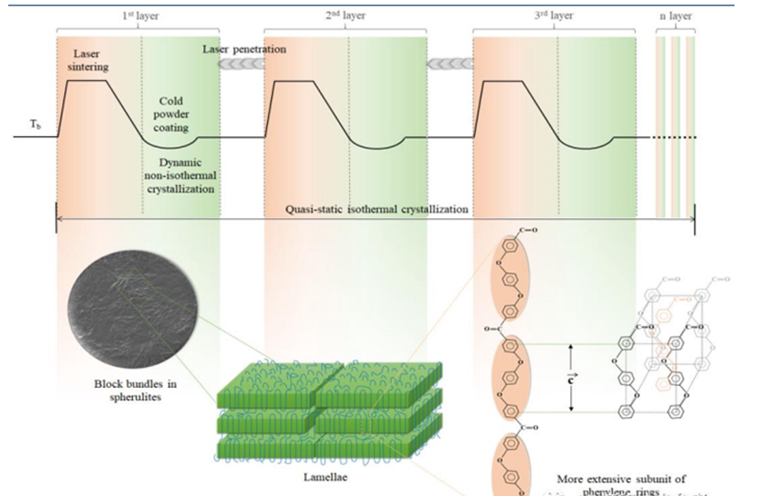
dddhhhThe temperature history during the printing process directly determines the form and speed of crystallization, ultimately affecting the strength, dimensional stability, and durability of the part,dddhhh pointed out a research team from Xi'an Jiaotong University. In laser sintering (such as SLS or HT-LPBF) processes, the molten pool undergoes rapid heating and cooling, involving dynamic non-isothermal crystallization and quasi-static isothermal crystallization processes. Studies have shown that through process optimization to achieve more sufficient isothermal crystallization, printed parts can obtain higher strength.
Process Integration: From Feasibility Verification to Final Component Manufacturing
Despite numerous challenges, the technical feasibility of PEEK 3D printing has already been verified. Since 2015, when the industry successfully printed a vehicle fuel intake duct (replacing aluminum) that can withstand 240°C temperatures and has excellent mechanical reliability, this technology has moved from prototype production to direct manufacturing of final-use components.
Currently, selective laser sintering (SLS) and fused deposition modeling (FDM) are the two mainstream processes. SLS is more suitable for manufacturing complex geometries and high-precision end-use components, such as the aforementioned cranial implant; while FDM has cost and time advantages in large-sized structural components and customized fixtures. The common challenge faced by both is how to maintain material performance without degradation during high-temperature processing and ensure good molecular diffusion and fusion between layers to avoid internal stress caused by crystalline shrinkage and resulting performance degradation.
The Road Ahead: Material Innovation and Process Intelligence
To break through existing bottlenecks, the industry is now working on both the material and process fronts simultaneously. On one hand, continuous carbon fiber reinforced PEEK (CF/PEEK) composites have become a leading direction, which can significantly enhance the tensile and impact resistance of the components, but also poses higher requirements for fiber impregnation and printing processes. On the other hand, optimizing the printing path and temperature field control through artificial intelligence algorithms to achieve intelligent prediction and adjustment of the crystallization process has become the key to process upgrading.
As the downstream market demands in areas such as aerospace lightweight structures, custom components for new energy vehicles, and human-shaped robot joints become increasingly clear, overcoming the technical difficulties of PEEK 3D printing is no longer just an academic issue; it has become an industrial competition to seize the future manufacturing high ground. All domestic research, education and industry sectors are accelerating their collaboration to promote this dddhhhnew material + new technologydddhhh combination, moving from the laboratory to a broader industrial blue ocean.
